ESWL
(Extra Corporeal Shockwave Lithotripsy)
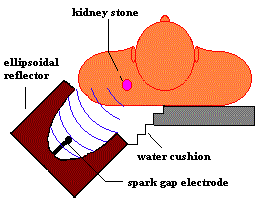 |
Extra Corporeal Shockwave Lithotripsy (ESWL) is
a procedure whereby urinary stones are broken using a special machine without
surgery. A shockwave is produced by a machine and is transmitted through the
skin in a gel-filled bag that is placed under the patient. When it meets a
urinary stone, it will break up crystals which the stone is made up of. It may
take up to two thousand shockwaves, or more, to complete the fragmentation.
Sometimes, multiple stages become necessary. |
Situations for Which ESWL is Indicated
ESWL is indicated for
stones in the kidney or the ureter.
Procedure
Before ESWL, it is
customary to place a ureteral stent from the bladder to the kidney. This is a
small caliber tube about the size of the tip of a lead pencil made of silicone.
This tube will help localize the stone during the procedure since X-Ray is used
to find the stone and bring it to the focus. After the procedure the stent
helps the patient pass the fragments. This happens because the stent makes the
ureter larger and the pieces pass by the stent more easily. The disadvantage of
having the stent is that in some patients the tip of the stent which
extends into the bladder can cause irritation and frequent urination. Since the
stent has no valves as a normal ureter, urine may back up to the kidney
specifically during voiding and this can cause pain in the flank. At times, the
stent can cause blood in the urine. This will usually subside after a period of
rest. In about a week or two after the procedure, a follow up x-ray will be
done. This is to make sure that the stone fragments have passed and it will be
safe to remove the stent. Most of the time, this is done in the office. This is
done by a cystoscopy.
Post-Operative Care
After the patient wakes up from anesthesia, they are taken to the recovery room where they will recover for about thirty minutes. Following that, they will go back to patient holding where they can be seen by their family. Sometimes, it is necessary to dismiss the patient with a foley catheter and a leg bag that will be removed the next morning.