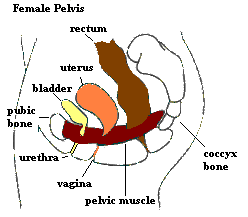
Urinary Incontinence
Urinary incontinence is defined as the involuntary leakage of urine.
Diagnosis
This is made by history as well as a physical examination. The urologist usually recommends a cystoscopy (an inspection of the bladder with a special instrument.) He also may recommend a urodynamic study (a pressure and electric study of the bladder and the urethra.)
There are Three Kinds of Leakage
- Total Urinary Incontinence. This condition occurs in patients who have severe damage to the nerves of the bladder or have had prostate surgery for cancer. It can also happen in patients who have had multiple procedures for bladder repair. There are different ways of treating this condition in females. In females, it is worthwhile to repair the bladder with a special procedure called a transpubic urethropexy. In some patients repair with an artificial sphincter is indicated.
- Urgency incontinence. A patient with urgency incontinence may feel a sudden urge to void and urine leaks out of the bladder. Most of the time this is impossible to control. Sometimes the leakage happens with no warning at all. THERE IS NO SURGICAL TREATMENT for this condition. The only therapies are:
a. Medical: Bladder relaxants (i.e. Ditropan) and urinary analgesics (i.e. Urela)
b. Bladder exercises that mostly consist of gradual training in delayed and timed voiding.
- Stress Incontinence. This type of leakage which occurs when a patient coughs, sneezes or jumps. This usually happens in female patients after multiple vaginal deliveries. The muscles relax and the bladder sags. The sphincter, the valve that keeps patients from leaking urine, is now outside the pressure zones of the abdominal cavity. So when they sneeze the pressure on the bladder is more than the pressure on the valve so leakage results.
Treatments for This Condition
1. Kaegel's exercises - whereby a patient is asked to exercise the muscles that surround the bladder and the ureter as many times as possible during the day. In some cases this exercise may straighten the muscles of the urethra and may help the situation.
2. Medications: Antihistamines may help in some cases.
3. Biofeedback: This is a therapy for the bladder and the urethra with a machine. This is not a permanent solution.
4.Bladder surgery
Incontinence Procedures
1. Marshall-Marchetti Operation. This procedure is an open surgery where the bladder is lifted up and brought over and tacked to the pubic bone from inside. The success rate on this procedure is 85%.
2. Transpubic Urethropexy. This procedure is similar to the Marshall-Marchetti operation, however, tiny holes are made in the pubic bone and one end of each suture is brought through the pubic bone and tied over the pubic bone lifting the bladder up. The success rate on this is probably between 95% and 98%.
3. Collagen and Teflon injection. This is where a paste is injected around the urethra with a special needles in the hope of increasing the resistance to the flow of urine so that in some cases this will help the incontinence.
4. Endoscopic Bladder Suspension. This is where a small incision is made in the skin above the pubic bone. Another incision is made in the vagina and needles are passed from underneath the skin into the vagina. Sutures placed here are pulled up and tied over underneath the skin thus lifting the bladder. The success rate of this operation is 50-70%. There are numerous variations of this procedure. TVT, TOT, and Stamey are a few.